With Valentine's Day approaching, romance is in the air and so are quotes! In our latest episode, TQ 12: Romantilicious, we dive into the movies to find unusual ways to say, "I love you."
If you are looking for a quotation to use in your sweetheart's card, don't rely on the greeting card industry when you can impress your love with examples from Clark Gable, Harrison Ford, Patrick Swayze, and others. After all, no one is more romantic than Sylvester Stallone.
Our mission, should we choose to accept it, is to explore strange old quotes, to seek out new sayings, and new ways of stating them in a galaxy not so far away.
Pages
Our mission, should we choose to accept it, is to explore strange old quotes, to seek out new sayings, and new ways of stating them in a galaxy not so far away. [Listen to our podcast at thequotablespodcast.libsyn.com ]
Tuesday, February 12, 2013
Monday, February 4, 2013
Ravens Win/Poe Wins?!?
So the Baltimore Ravens won the 47th Super Bowl last night, and we released TQ 11 Nevermore the week before. Hmm. Seems to me there was something nefarious afoot with the "power surge" that caused the lights to go out and the Ravens to win the big game. Could it be a "tell tale heart" from the great beyond? Maybe you should listen to TQ 11 Nevermore to find out, eh?
Listen for yourself and find the truth! "Nevermore"!!! Ha ha ha (maniacal laughter echoing)
Ed
"SavageTechman"
2/4/13
Listen for yourself and find the truth! "Nevermore"!!! Ha ha ha (maniacal laughter echoing)
Ed
"SavageTechman"
2/4/13
Thursday, January 31, 2013
TQ 11 Nevermore Behind The Quotes
This episode of The Quotables podcast covers some famous quotes by a couple of my favorite poets. Being a poet myself, I appreciate the written word and understand how a simple phrase can change the way you perceive life and everything therein. Depending on the right word, the right position of words, or the exemption of a word, can change how you experience the thoughts and feelings conveyed.
Edgar Allen Poe was such a wordsmith. His use of words and how he phrased them created an atmosphere of mostly dark images that transported the reader into his fantastical, yet somewhat psychotic world that he so eloquently fashioned into being. I found a fondness, early on, for Poe's unique perspective on life. The sadness, despair, the longing he represented in his vast writings, from poems, to stories of characters that were tormented by loss, or simply just driven to madness. Poe demonstrated throughout his many masterpieces an examination, such as the likes of a physician, in his meticulous constructions of words. Dark and brooding, dank with downtrodden displays of desperation, devilishly and delectably he delved into the distraught dwellings of the minds of his most disillusioned doppelgangers.
From "The Tell Tale Heart" to "The Raven" to my favorite poem of all time, "Annabel Lee", darkness was always something that plagued Edgar his whole life. He knew loss, he felt the pains of not being appreciated for his talent, and he lived his life clouded by the demons of doubt and determination to escape his dungeon of despair. Edgar Allen Poe would only know true peace after his death, I would assume, for he seldom enjoyed that one peace he searched for, never quite achieving in his written words. His studies on the darker side of the human condition where the heart and mind are caught in a dance between wants and needs, with his sanity dangling so delicately in the balance, proved to be very insightful and cathartic for those who might find themselves on the fringe of happiness. Poe's best work, I think, still stands the test of time and teaches us to delve a little deeper than just the status quo of our sometimes average lives, and invites us to journey into madness, if ever so briefly, to come back to the "sane" world reinvigorated to better oneself. A world where, maybe if through the journey alone, sadness and despair will find you, "Nevermore"!
Another poet's words we discuss on this episode are from Robert Frost. A great man who, compared to Edgar Allen Poe, was much brighter through his use of the written word. "The Road Less Traveled" is another favorite poem of mine. I can easily recall learning and reciting it line for line admiring the beautiful images it portrayed. The poem was not just a visual experience, but it was more a tale of taking a chance in life by a less traveled path to your destination. Reaching out a little beyond your own self imposed or even societal boundaries.
Frost was a "city boy", but often wrote of country living. focusing on the simpler things life had to offer. Like the leaves, the trees, nature, you could see the picture he so eloquently painted, and they were places you would want to take a stroll in. Even in "Stopping By The Wood On A Snowy Evening" you wanted to be there. I would say Frost made you an environmentalist, even if you had never considered that to be something you were. Hope and responsibility to do the right things in life, to make the right decisions, and to stand firm in those decisions.
I hope you enjoy listening to TQ 11 Nevermore as much and Cheryl and I enjoyed bringing the episode to fruition, and we thank you for listening!
Ed
"SavageTechman"
1-31-13
Tuesday, January 8, 2013
"A" Big Deal: What Did Neil Armstrong Say?
Sometimes the most important words are the smallest ones. Once, I turned in a college paper only to realize that I had left a single word out of my thesis statement. It was just three little letters: n-o-t. That omission meant that not one of the following 12 pages offered support to the thesis statement. I ran up to the pile of papers, and quickly penned in the missing word. Fortunately, Dr. MacFarland was amused rather than irritated.
For the last half of his life, Neil Armstrong probably wished he could pen in his missing word too. In one of the most famous quotations of the twentieth century, his omission of the one-letter word "a" caused him to contradict himself. Perhaps I should be ashamed to admit that I never noticed. When he said, "That's one small step for man, one giant leap for mankind," I knew exactly what he intended. Maybe you didn't notice either. When he left out the indefinite article (that's right, I know my parts of speech), it changed his literal meaning to "one small step for humanity, one giant leap for humanity." Well, Neil, which is it? Did we take a small step or a giant leap?
For years, Neil and some sound technicians insisted that the "a" was garbled by the technology of the day. Others contended that he simply misspoke. Recently, a BBC interview with his brother, Dean Armstrong, revealed that he absolutely intended to say "a man," and now that has led to even more controversy. Find out why in this week's podcast. Listen now.
Tuesday, December 11, 2012
Facebooking for Quotes
Listen to this week's episode, Facebooking, now.
So, when you join the world's best-known social network, they ask you innumerable questions. Where do you live? Where did you go to school? Who are your relatives? When is your birthday? Do you like boys or girls?
At The Quotables, however, we have always been fascinated that they also ask you to identify your favorite quotations. Why? It's not exactly the kind of thing you ask at a cocktail party or even as a way to try to build a friendship. I would bet that no one ever bellied up to a bar and asked, "Hey, baby, what's your favorite quotation?"
Nevertheless, quotations have become a huge part of the Facebook culture. Not only do most people have at least one on their "About" page, but some people actually spend time trawling through them. Don't believe me? Check out the post "My 50 Favorite Facebook Quotations" on Blog Income for Women. Plus, there are tons of posts where people share quotations to express their thoughts and many, many pages devoted to adding pithy sayings and profound remarks to funny or beautiful pictures. These get posted and re-posted continuously. Of course, they are not always accurately attributed, and some are even intentionally inaccurate like the one below:
This well-shared "Lincoln" quote has been created and re-created by a variety of people using different images and different variations of the quotation. There is even a version with Lincoln's name, but Benjamin Franklin's image. Then, there is the version with Ben Franklin saying, "You can't trust quotes on the internet." But, apparently, there is a battle in cyberspace, because William Shakespeare takes the opposite perspective:
Oh wait, that IS Shakespeare's image BUT with Franklin's name AND a title Franklin never held. So, enjoy your quotations on Facebook all you want, but be careful if you decide to use one in your English paper. In the meantime, enjoy our new segment, where we randomly select Facebook friends and share their favorite quotations with you. Listen now.
Tuesday, December 4, 2012
Speaks Yoda Does
In this week's episode (listen now), we celebrate the sayings of the great Jedi master Yoda from the Star Wars universe. (Ed is such a Star Wars fan that he once featured in the newspaper for being the first person in line to see one of the newly released films! Of course, I barely escaped similar notoriety when pandas arrived at the local zoo, thanks to pandamaniac sister!!)
Yoda is, of course, wise in addition to being small, green and powerful. However, his wisdom is delivered with a distinctive syntax that gets the words out of order. So, when TomTom, the navigation company, decided to offer Yoda (voiced by Frank Oz), as one of its celebrity voices, it offered a perfect opportunity to create a hilarious "behind the scenes" video of the taping, which you can watch below.
For more about Star Wars, Star Trek, and other geeky topics, check out our Digital Mancave podcast and Digital Mancave blog.
Thursday, November 29, 2012
The Diana Debate: Behind the Scenes at TQ
Ed and I rarely disagree about anything (except what temperature the house should be), so our friends would have been shocked to overhear our pre-show meeting about this week's episode, TQ5: Ew-logy (listen to the episode now). Of all things to fight over, we argued over Princess Diana!
To be fair, I was the most heated. After all, I am a self-proclaimed princess expert who has studied royalty for more than 30 years, so I feel that my opinions are very well-qualified. But, here's the problem: I don't think Diana was a saint. I don't think she "saved" the royal family. I don't think she was a better parent than Prince Charles. (Read my Princess Palace post, Diana and Me.)
Don't get me wrong. I greatly respect her work, her beauty and her legacy. But, I also admire the work of Prince Charles and the rest of the royal family, which started long before anyone ever heard of Lady Diana Spencer.
On the other hand, I have very limited respect for Diana's brother, Charles Earl Spencer, who delivered Diana's eulogy at Westminster Abbey. So, as we discussed which parts of his eulogy for her to include on the podcast, there were parts I absolutely refused to read. Ed was befuddled. Like many people, he thinks Diana was a tragic victim of a cold royal family. "She was so young," he said in her defense. Yes, she was 19 when she became engaged, but her own family helped push her into it. Where were they when it fell apart? And, she didn't stay "so young"--she was 34 when she gave that scathing interview to Martin Bashir, which upset her own children so much.
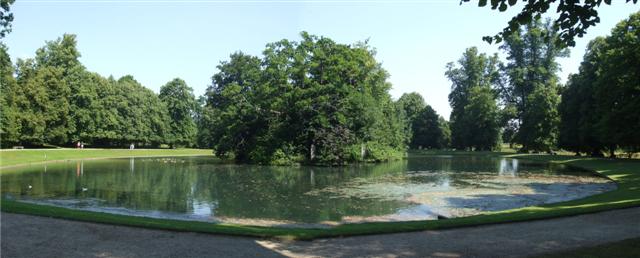
| Diana's burial place: The island in the lake at Althorp Estate, which is held by Earl Spencer. |
I guess I feel like those who would sanctify Diana the way Republicans feel about liberals or Democrats feel about Tea Party-ers. So, Ed caught the edge of 20 years of my frustration on this topic, which was greatly enflamed by many of the things Earl Spencer said that summer day in 1997. As I told Ed, it was like he told The Queen "eff you" in the very church where she was married and where she was crowned. For the Earl to pledge to Prince William and Prince Harry that Diana's "blood family" would ensure that they were raised as Diana wanted was pure hypocrisy. Not only had Diana regularly been on the outs with various members of her family, the earl himself was living thousands of miles away at the time in South Africa. When he moved back to England, he left his own children there and started another family with wife #2. From there, he had a brawl with a friend, probably had an affair, divorced wife #2, got engaged, broke that engagement, and married wife #3, who gave him his seventh child earlier this year. All of which certainly makes him a fitter role model for his princely nephews than the royals. (Insert sarcasm sign.)
Subscribe to:
Posts (Atom)